The Seattle Japanese Garden describes its master stonemason's method as "listening to the stones and putting them where they want to go." That stonemason is Suminori Awata, a 15th-generation master of the Anoshu lineage. He spent the summer building a new granite wall at the north end of the garden's central pond, and the wall was finished on September 10. This Thanksgiving weekend is the last time anyone can see it in 2026. The garden's final day of the year is Sunday, November 29, from 10 a.m. to 4 p.m., and then it closes for winter maintenance from December through February.
After Sunday, the Arboretum's winter season moves a few minutes' walk north to the Joseph A. Witt Winter Garden, which UW Botanic Gardens says is at its best from late November through the end of March, "when much of the rest of the park is relatively quiet and subdued." The Japanese Garden closes just as the Winter Garden begins its season, and that timing shapes a resident's winter in the Arboretum.
Sunday Is the Last Look at the New Wall Until Spring
The wall is called an ishigaki, and it's the centerpiece of the garden's $2.8 million Ishigaki Wall & Accessible Pathway project. It replaces a deteriorating stone retaining wall and adds an accessible loop for visitors using wheelchairs, strollers or walkers. Ishigaki walls in the Anoshu tradition start with large granite boulders split and shaped by hand into cornerstones. Smaller stones of varied shapes go on top, and ballast stones fill the gaps instead of mortar. The garden says walls built this way are earthquake-resistant and meant to stand for centuries. The granite came from the greater Cascadia region.
If you skipped the garden this year to wait out the construction, here's how 2026 went. Seattle Parks closed the whole garden from June 22 to July 27, reopened it on Tuesday, July 28, and kept the north section closed through November while crews worked. After the wall was finished, Awata and most of the Green Man Builders crew left on September 14. Project lead Kyle Schlagenhauf of Green Man Builders has stayed on with the remaining crew to build the accessible pathway along the north end of the pond.
The Arboretum Foundation says the wall will open fully to the public in spring 2027, so this weekend's view is the in-between version. Most of the fall foliage has already dropped, but the Foundation's November guide points visitors to the camellias blooming inside the garden and the moss covering the ground along the western pathway.
At the north end, also look for the Yamasaki Pine. This century-old black pine was donated by Richard "Dick" Yamasaki, the Seattle-born nisei gardener whose collaboration with designer Juki Iida shaped the garden. The project plan keeps the tree and incorporates it into the new wall. In a year of new stonework at the north end, the pine is the link to the garden's past.
The Witt Winter Garden, Up the Hillside Trail
From the Japanese Garden gate, winter in the Arboretum moves uphill toward Graham Visitors Center. The Witt Winter Garden is a short walk from the center via the Hillside Trail. It's a central lawn ringed by tall cedars and firs, with smaller trees, shrubs and perennials chosen for color, fragrance and bark in the darkest months. UW's brochure gives the route: cross Arboretum Drive East from the west side of the visitors center and take the diagonal trail south.
The garden is already starting its season. The Foundation's November 2026 guide reports the hybrid mahonias 'Lionel Fortescue' and 'Arthur Menzies' in flower, along with sasanqua camellias. UW's 2024 brochure lists those same mahonias as December and January bloomers, so this year's flowers are early. The brochure also says the nectar-rich yellow flowers draw the Arboretum's year-round Anna's hummingbirds.
The Foundation puts the garden's full peak in January and February, so a walk here keeps changing well past New Year's. The brochure is a planting map with notes on each bed, and the beds work best over several visits:
- Bed A: witch hazel cultivars and the winter-flowering mahonias.
- Bed B: Azara microphylla, a lacy evergreen tree whose tiny yellow flowers smell like white chocolate, plus silk-tassel bush and the fruity scent of winter honeysuckle at the south end of the bed.
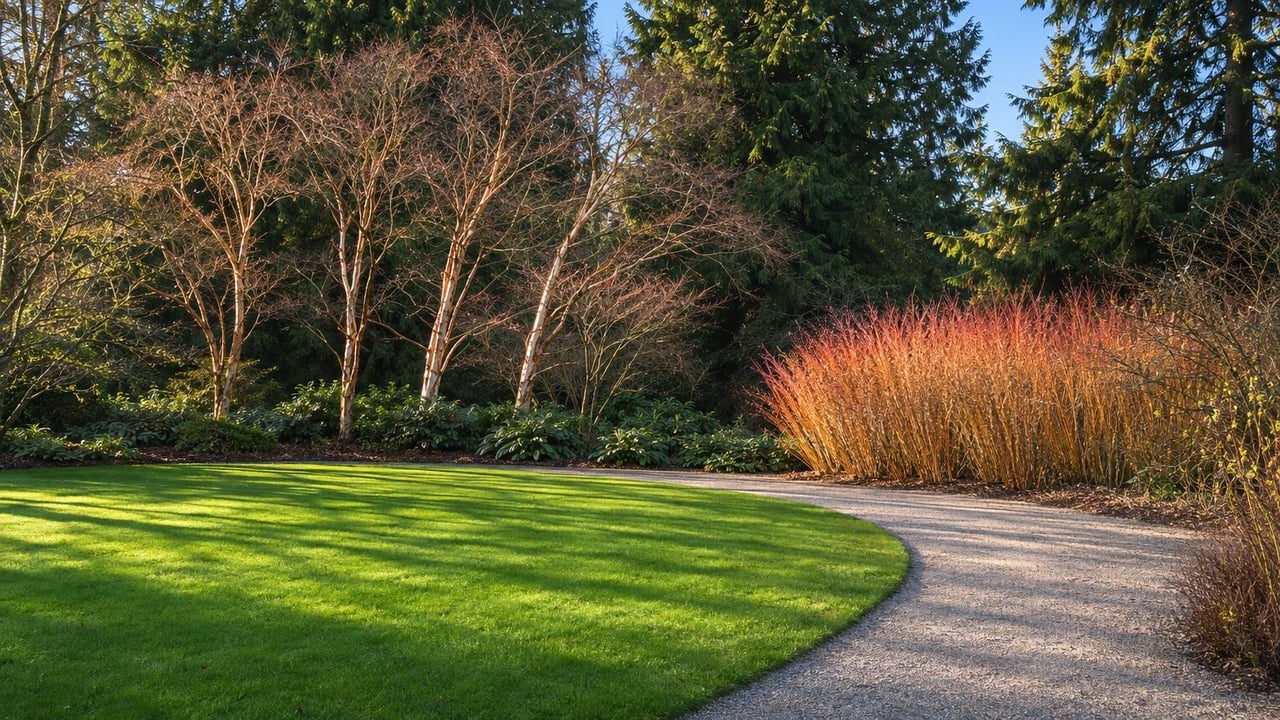
- Bed C: known informally as the "twig bed," with Cornus sanguinea 'Midwinter Fire' glowing yellow, orange and red above black mondo grass. The wintersweet here, Chimonanthus praecox, blooms in January with pale cream flowers and reddish centers.
The bark beds are best when the sun is low. UW points to the northern Chinese red birch, Betula albosinensis var. septentrionalis, whose bark peels in strips of cream, salmon and orange and is "stunning when backlit by the low winter sun," along with a mature paperbark maple. For fragrance, UW names sweet box, Sarcococca, and Daphne odora 'Zuiko Nishiki'.
Camellias and Hollies on Either Side of the Japanese Garden
The Japanese Garden's camellias close with the garden on Sunday, but the Arboretum's main Camellia Collection, toward the south end of Arboretum Drive, stays open. Mature specimens there date to the 1940s, 1950s and 1960s, planted along the drive and around the semicircular stone bench in the main grove. The Foundation names 'Apple Blossom', 'Cleopatra', 'Briar Rose' and 'Tago-no-tsuki' among the varieties. On the way, the guide suggests stopping at the large 'Arthur Menzies' mahonias on Arboretum Drive just above Rhododendron Glen.
Just north of the Japanese Garden is the Holly Collection: more than 200 holly specimens representing over 80 species and cultivated varieties. It's part of a multi-site Nationally Accredited Plant Collection administered through the American Public Gardens Association. The berries come in reds, yellows, oranges and more. After Sunday, the closed garden sits between two collections that are at their best in December.
The two-mile paved Arboretum Loop Trail, open to walkers and bikes, connects much of this. It passes the Woodland Garden and the Pacific Connections Garden, and it can be reached from Graham Visitors Center. The parts of the Arboretum still under construction this fall are covered in our earlier Washington Park walk post.
Two December Weekends at Graham Visitors Center
For the rest of the year, Graham Visitors Center is the Arboretum's busiest spot. Its first big weekend is Gifts & Greens Galore on Saturday, December 5, and Sunday, December 6, from 10 a.m. to 4 p.m. Parking and admission are free, and payment is by card or mobile only. The wreaths are made by volunteers from greens the horticulture team gathers across the Arboretum, and the Foundation expects them to sell out on Saturday. The market also carries Jonboy Caramels, Chukar Cherries, honey from the Puget Sound Beekeepers Association, and pressed-flower cards from the Hyde Herbarium.
New this year, the Foundation asks guests not to bring greens or other plant material to the event, because moving plants into the gardens can introduce pests and diseases. Harpist Leslie McMichael plays through the Saturday sale, and a quartet from the Seattle Girls Choir sings from noon to 1 p.m. on Sunday. Narrated one-hour winter tram tours leave at 11 a.m. and 1 p.m. both days and cost $15, or $12.50 for members, as listed for the 2026 event.
The second weekend falls around the longest nights of the year. The Winter Solstice Luminaria Walk runs Friday, December 18, and Saturday, December 19, with entry at 6 or 7:30 p.m. Tickets for 2026 are $30 general admission, $25 for members and $10 for kids under 12. The evening starts in Wisteria Hall with a hot drink from Mr. Whiskers, a Yule log cookie from Pomme Pomme Bakery and a performance by UW's University Chorale. Then comes a light installation by the Seattle Design Nerds and a self-guided, one-mile round-trip loop lit by luminaria. Leashed dogs are welcome outdoors, and since the Arboretum is very dark at night, the Foundation suggests bringing a flashlight. UW Alumni Association members have their own night on December 17. For families with toddlers, Winter Solstice Family Nature Classes for ages 2 to 4 meet December 9, 10 and 12 from 9:30 to 11:30 a.m.
All of this now runs under one name. On January 9, 2026, the Arboretum Foundation and UW Botanic Gardens announced they would combine under the Seattle Botanic Gardens name, which is now on the Foundation's event pages and which covers the Arboretum, the Japanese Garden and the Center for Urban Horticulture, according to UW News. The winter calendar continues into 2027, with Arboretum forest-bathing walks on January 30 and February 20 and a walking tour on February 13 on the UW Botanic Gardens calendar. Those February walks come during the Winter Garden's peak, and the Japanese Garden won't reopen until its winter closure ends.
If this winter's walks to the Witt Winter Garden have you thinking about what a home on these streets would be like through the year, Mumma Homes would be glad to compare notes on the Washington Park neighborhood. Let's Connect.